


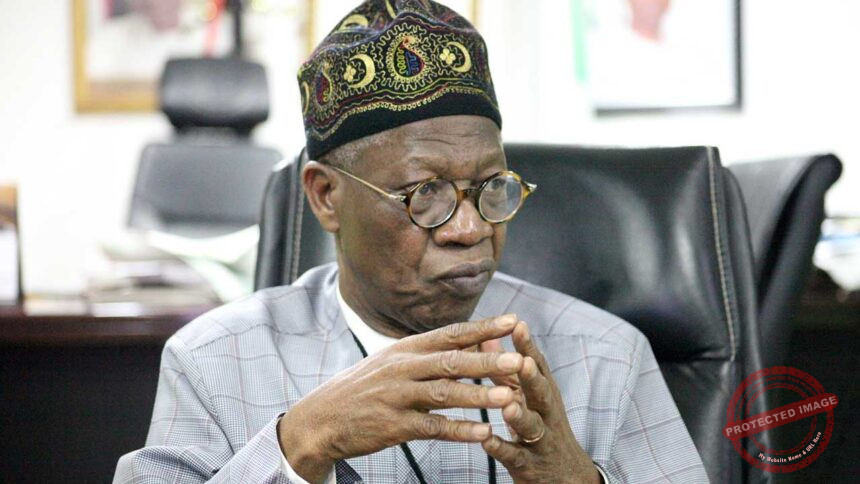

Former Minister of Information and Culture, Alhaji Lai Mohammed, has revisited two of the most controversial moments of his tenure — the suspension of Twitter’s operations in Nigeria and the heated national debate surrounding the alleged killings at the Lekki Toll Gate during the 2020 EndSARS protests.
Speaking during an interview on Prime Time, an Arise Television programme, the former minister described the Twitter ban as “one of the hardest decisions” he had to make while in office, insisting it was taken solely to protect national interest.
“Twitter Ban Was My Toughest Decision”
Mohammed explained that at the time, Twitter had evolved into a preferred platform for individuals and groups attempting to undermine national stability.
“One of the most difficult decisions I took was suspending Twitter’s operations in Nigeria,” he said, stressing that the move was not triggered by the deletion of former President Muhammadu Buhari’s tweet as widely speculated.
He recalled approaching Buhari personally:
“I asked him, ‘Sir, we need to suspend the services of Twitter.’
And he asked, ‘Is it because they deleted my tweet?’ I said, ‘No, sir,’ and I gave him examples.”
Mohammed said he had, for years, warned about the dangers of unregulated social media.
“From 2016 to 2023, I consistently said that unregulated social media could be a disaster. I wasn’t trying to stifle the free press, but we needed regulation.”
“No One Died at Lekki Toll Gate” — Mohammed Reiterates
In the same interview, the former minister also doubled down on his long-held stance concerning the EndSARS protests, insisting that there were no deaths at the Lekki Toll Gate.
He argued that, despite the magnitude of the claims made in 2020, no individual or family has come forward within the last five years to declare a missing relative who allegedly died at the toll gate.
“People died in many places during EndSARS, but saying there was a massacre at the toll gate is fake news,” he said.
“I still stand by my pushback: nobody died at the Lekki Toll Gate. CNN was not there. They relied on second-hand and third-hand information.”
Using a metaphor, he added:
“If a man has a goat and the goat does not return home at night, he will go out to look for it. Five years on, nobody has said: ‘My son or my ward went to the toll gate and didn’t come back.’”
Mohammed insisted that the toll gate narrative was built on misinformation and amplified by international media outlets.
A Legacy Shaped by Controversy
The former minister’s statements have once again sparked public debate, revisiting two of the most emotionally charged topics in Nigeria’s recent history. As conversations resurface around security, social media regulation, and the 2020 protests, Lai Mohammed’s latest remarks are bound to reignite scrutiny of decisions made during his tenure.
You can get every of our news as soon as they drop on WhatsApp ...To get all news updates, Join our WhatsApp Group (Click Here)