



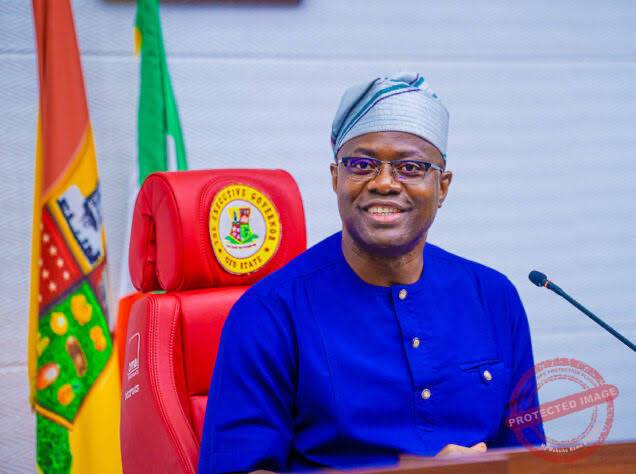


Few days ago, Governor Seyi Makinde, while addressing the press after his meeting with President Bola Ahmed Tinubu, made an insightful and timely statement on the importance of adopting a bi-partisan approach to leadership and governance in Nigeria. Truth is, in a country that has been so deeply polarised along party, ethnic and religious lines, such a call for cooperation in governance is one that should ordinarily be welcomed by all well-meaning Nigerians.
Quite unfortunately, many an observer have chosen to interpret the Governor’s statement differently. Some have argued that his remarks lend legitimacy to the growing perception that the Tinubu-led administration is quietly promoting a one-party system. Meanwhile, it is important to note that Governor Makinde is not a stranger to defending democratic values. He is one of the few prominent voices within the PDP who has consistently and vehemently condemned any attempt, overt or covert, to push Nigeria into a one-party State.
Nonetheless, considering the growing anxiety amongst Nigerians that President Tinubu may be covertly working to weaken the democratic space by engineering crises within opposition parties, their fear and doubt is real. And, this is based on the increasing instability the President has orchestrated within major opposition parties and the manner in which internal divisions are being exploited. The ignoble role being played by Nyesom Wike is an evidence of this calculated effort to weaken opposition and it is no doubt a part of a broader strategy to weaken the party’s capacity to function as a formidable opposition from within.
It is important to remind the President and his co-travellers that democracy is not about uniformity of thought, unanimity of opinion, or blind loyalty to one individual. Democracy thrives on diversity of ideas, the strength of institutions, and the existence of credible opposition capable of holding government accountable. Any attempt to dismantle opposition parties or collapse Nigeria into a one-party arrangement, where everyone is forced to praise and idolise the President, stands against the core tenets of democracy and constitutional governance.
In this regard, Governor Makinde deserves commendation for his consistent efforts at sustaining the PDP against internal sabotage and external pressures. While some political actors have chosen personal ambition over party survival, Governor Makinde has continued to emphasise the need for rebuilding party structures and protecting the integrity of opposition politics. This is more evident in his donation of a building to the PDP in Oyo State last week. It takes courage to remain committed to party cohesion at a time when deliberate efforts are being made to fracture and weaken the opposition.
Meanwhile, despite the fact that Nigerians have been enduring severe hardship under the Tinubu’s administration, there appears to be a strange preoccupation with political domination rather than governance. Citizens are confronted daily with inflation, rising food prices, insecurity, unemployment and declining purchasing power. Yet, rather than fix these urgent issues, frantic efforts seem to be geared towards consolidating power and neutralising opposition voices. This trend raises legitimate fears that Nigeria may be descending gradually into the rule of an emperor; a dangerous development for democratic stability.
Hence, the President must be cautioned not to plunge the country into a crisis that could become difficult to control. In fact, at this critical point in the country’s democratic journey, the country needs committed politicians like Governor Seyi Makinde who are willing to resist authoritarian tendencies and defend democratic ideals. The disposition of President Tinubu towards governance is raising dangerous concerns as he seems to be working to perpetuate himself in power by weakening democratic guardrails, compromising institutional independence, and using temporary control of institutions to maximum partisan advantage. These are warning signs that must not be ignored.
It is high-time Nigerians understood this pattern and conducted a comparative analysis with countries where similar syndromes have become deeply entrenched. Across Africa, history is filled with examples of leaders who started as democratic actors but gradually transformed into sit-tight dictators. From Uganda to Ivory Coast, from Cameroon to Tanzania, there are men who began their political careers with the language of democracy but later used State power to strangle opposition, weaken institutions, intimidate critics and ultimately establish near-permanent control over their countries. They became dictators cloaked in civilian clothing, maintaining the outward appearance of democracy while undermining its true substance.
These leaders did not become dictators overnight. They achieved it through gradual steps: manipulating party structures, weaponising State institutions, sponsoring division among opponents, controlling media narrative, and ensuring elections became mere formalities rather than genuine democratic contests. This is why Nigerians must be vigilant. Democracy dies not only through military coups but also through civilian manipulation and calculated political engineering.
It is on this basis that I admire the bold move being made by Governor Makinde regarding his involvement in the Minna meeting held a few days ago. While the full details of the meeting have not been made public, against the nuisance value being exhibited by former Governor Ayo Fayose on social media, the meeting carries a significant message. It reflects the growing awareness among opposition actors that disunity is a luxury they can no longer afford. It also signals the urgent need for opposition parties and patriotic leaders to begin strategic consultations aimed at preserving democratic competition and preventing authoritarian consolidation come 2027.
Governor Makinde’s participation in the meeting is a clear demonstration of him walking the talk. His earlier recommendation of a bi-partisan approach is not a call for political surrender, but rather a call for mature cooperation in addressing Nigeria’s challenges. Bipartisanship, in its true sense, does not mean collapsing opposition into the ruling party. It means working together where national interest demands unity, while still maintaining strong ideological competition, accountability and democratic checks.
To rescue Nigeria from the claws of creeping dictatorship in Abuja, politicians across party lines must unite with civil society organisations, labour unions, student bodies, traditional institutions, religious leaders and credible non-political actors to defend democracy. The country cannot afford a situation where power becomes personalised and opposition becomes criminalised. Nigerians must insist on a political environment where dissent is respected and elections remain competitive.
Kazeem Olalekan Israel (GANI) writes from Ibadan, Nigeria.
You can get every of our news as soon as they drop on WhatsApp ...To get all news updates, Join our WhatsApp Group (Click Here)