





Last Saturday in Ibarapaland, the air carried the kind of solemn electricity reserved for moments that bend history. As the traditional rulers gathered; robes flowing, drums rumbling softly beneath the breath of the hills, they conferred the titles Aare Asoludero and Yeye Aare Asoludero on Governor Seyi Makinde and his wife, Engr. (Mrs.) Tamunominini Makinde. It was more than a ceremony; it was a proclamation.
In Yoruba cosmology, chieftaincy titles are never ornamental decorations. They are earned through service that steadies a people, sacrifice that strengthens a land, and impact that reshapes daily life. By honouring Makinde, the custodians of Ibarapa’s heritage declared him a stabiliser, a builder, and a guardian of communal welfare. And what made the moment thunder with deeper meaning was its perfect alignment with modern evidence: the 2025 Phillips Consulting State Performance Index (pSPI), which ranked Oyo State as the most liveable in Nigeria. Tradition spoke. Data echoed. Together, they affirmed a single truth.

The convergence of these two recognitions, one rooted in tradition, the other grounded in empirical analysis, tells a compelling story about Oyo State’s transformation under Makinde’s leadership. It is a story of deliberate policy choices, sustained investment in human and physical infrastructure, and a governance philosophy that places people at the centre of development.
Historically, the title Aare Asoludero is associated with peacebuilding, protection, and societal stability. By conferring it on Makinde, the traditional rulers of Ibarapalandhighlighted his contributions to security, intercommunity harmony, and infrastructural development. Ibarapa, once beset by farmer–herder tensions and banditry, has witnessed notable improvements in stability over the past five years. Makinde’s administration strengthened local security through the Amotekun Corps, improved intelligence coordination, and invested in communitylevel peacebuilding initiatives.
But the honour extended beyond security. It also recognised Makinde’s developmental footprint in Ibarapaland, from rehabilitating inner roads in Eruwa to the ongoing construction of the Ido–Eruwa road, a project poised to unlock economic opportunities for farmers, traders, and transporters. Traditional rulers described him as a “foremost achiever and humanist,” underscoring the humancentred nature of his governance.
While traditional institutions speak for lived community experiences, the Phillips Consulting pSPI speaks for measurable outcomes. The 2025 report assessed states using hard data and perception surveys from nearly 10,000 Nigerians. Oyo State emerged as the most liveable in the country, outperforming others in infrastructure quality, safety, environmental cleanliness, governance, and service delivery.
The alignment between the pSPI findings and the basis of Makinde’s chieftaincy title is unmistakable. Both point to the same underlying reality: Oyo State has become a more functional, stable, and citizenfriendly environment under Makinde’s stewardship.
One of the most visible aspects of Makinde’s governance is his aggressive investment in infrastructure. Roads, the arteries of economic activity, have received unprecedented attention. The administration has completed or initiated scores of road projects across the state, connecting rural communities to markets, improving mobility, and reducing travel time.
In Ibarapaland, the Ido–Eruwa road stands out as a transformative project. Long a symbol of neglect, it had hampered trade and isolated communities. Its reconstruction has already begun to stimulate economic activity, with farmers reporting easier access to markets and transporters experiencing reduced vehicle wear and tear.
Beyond roads, Makinde’s administration has upgraded the Ibadan Airport, built modern bus terminals, expanded street lighting, improved drainage systems, and executed urban renewal projects. These interventions have enhanced the aesthetic and functional quality of urban centres like Ibadan, Ogbomoso, and Oyo, contributing to the state’s strong pSPIinfrastructure ranking.
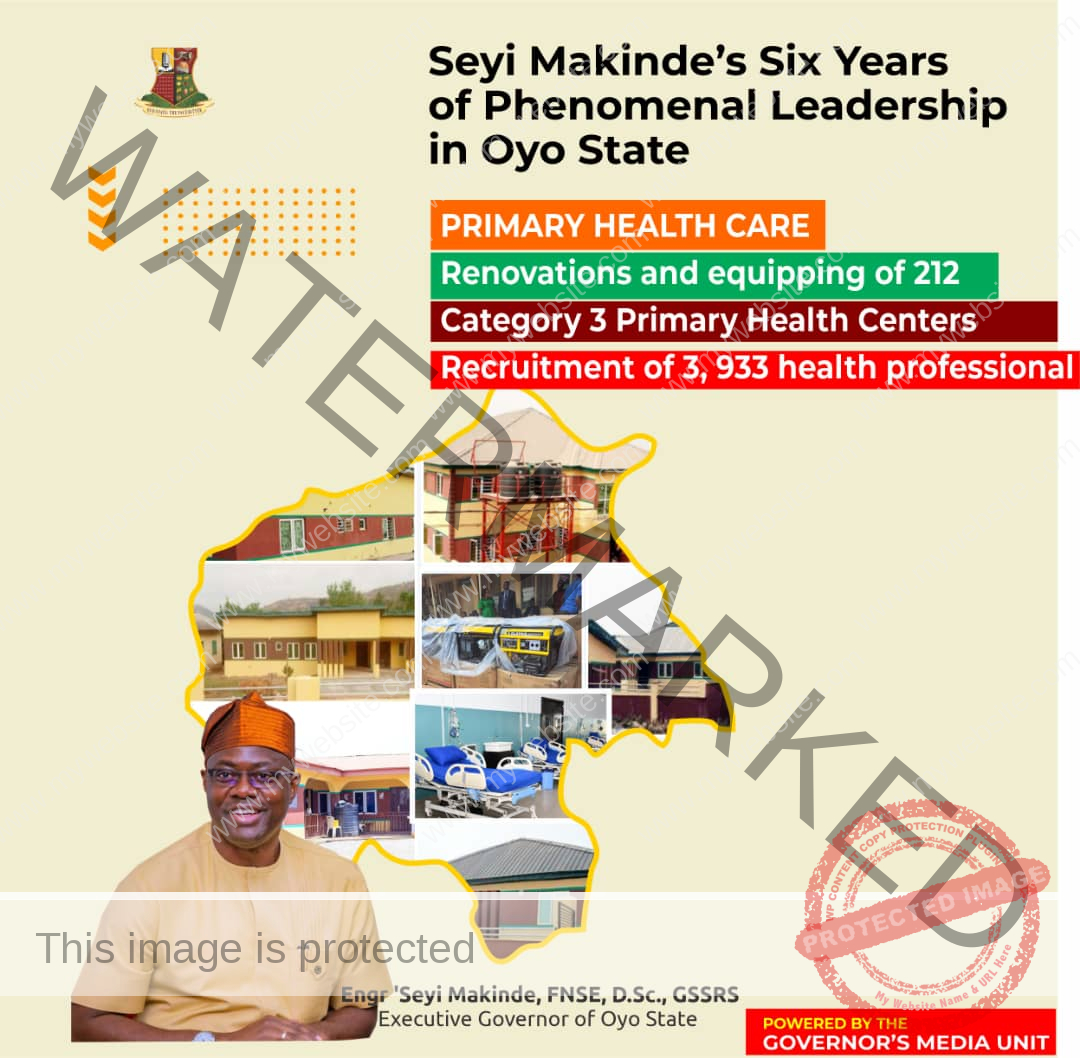
A state cannot be liveable if its healthcare system is weak. Recognising this, Makinde embarked on a comprehensive overhaul of primary healthcare. About 300 primary healthcare centres (PHCs) were renovated, equipped with modern facilities, and staffed with nearly 4,000 newly recruited health workers.
This intervention has improved access to healthcare for both rural and urban residents. In Ibarapaland, communities that once travelled long distances for basic medical care now have functional PHCs within reach. These improvements significantly boosted Oyo’s performance in the pSPI’s health and social services indicators.
Makinde’s education reforms have been equally impactful. His administration constructed over 100 model schools, built more than 400 new classroom blocks, and recruited about 20,000 teachers to address staffing gaps. School fees in public primary and secondary schools were abolished, reducing financial burdens and increasing enrolment.
Tertiary institutions have also benefited. Oyo State became the sole owner of Ladoke Akintola University of Technology (LAUTECH), Ogbomoso, and expanded it into a multicampus institution with the establishment of the College of Agriculture and Renewable Resources in Iseyin. The Emmanuel Alayande College of Education was upgraded to a university, further strengthening the state’s highereducation landscape.
These interventions have improved learning outcomes, reduced overcrowding, and enhanced overall education quality, reflected in Oyo’s strong pSPI education scores.
One of the most remarkable aspects of Makinde’s governance is his fiscal discipline. Oyo State’s internally generated revenue (IGR) grew from ₦15 billion annually before 2019 to over ₦65 billion in 2024. This growth was achieved not through punitive taxation but through improved tax collection efficiency, expansion of the tax net, and economic stimulation driven by infrastructure investment.
The increased revenue has enabled the state to fund capital projects, pay salaries promptly, and maintain financial stability. The pSPI recognised Oyo’s strong fiscal performance, noting its prudent financial management and sustainable budgeting practices.
Safety is a core component of liveability, and Oyo’s improved security environment was a major factor in its pSPI ranking. Under Makinde’s leadership, the establishment and strengthening of the Amotekun Corps, reinforced by sustained collaboration with federal security agencies and deliberate support for local hunters and vigilante groups, created a communitybased security architecture that has proven effective in deterring crime, improving intelligence gathering, and responding swiftly to local threats. This integrated, multilayered approach has restored confidence across communities and reinforced the stability that underpins Oyo State’s rising liveability profile.
In Ibarapaland, where insecurity once threatened livelihoods, residents now report greater confidence in their safety. The traditional rulers’ decision to honour Makinde with the Aare Asoludero title reflects this improved security landscape.
The pSPI report also highlighted Oyo’s strong performance in environmental cleanliness and urban management. Waste management systems have been upgraded, with better collection, disposal, and recycling processes. Urban centres have become cleaner, more organised, and more aesthetically appealing, contributing to public health and overall quality of life.
Perhaps the most compelling validation of Makinde’s governance is citizen satisfaction. The pSPI’s perception surveys revealed that residents feel safer, more supported, and more optimistic about the state’s direction. This sentiment mirrors the confidence expressed by traditional rulers, who described Makinde as a leader whose impact is felt in daily life.
Nowhere was this more visible than in Ibarapaland last Saturday, the day of the conferment.
As Makinde stepped forward to receive the title Aare Asoludero, a wave of emotion swept through the crowd like wind across ripe fields. Their cheers rose not as noise but as testimony. Their smiles carried the weight of gratitude. For them, this was more than a ceremony; it was a communal declaration that the one who steadied their land had earned the drumbeat of their joy.
From their elevated seats, the traditional rulers watched with quiet pride. These custodians of heritage, men whose voices hold the weight of history, saw in the vast crowd a verdict more powerful than any proclamation. To them, conferring the title was not an act of ceremony but an affirmation of truth.
The Aare Asoludero title and the pSPI ranking may come from different worlds — one ancient, one modern — yet they testify to the same reality. Tradition raised its staff; data raised its charts. Both pointed to a state transformed, a people uplifted, and a leader whose work is felt in the rhythm of daily life.
From roads that reconnect forgotten communities to hospitals that restore hope, from schools that awaken potential to security systems that steady the land, Makinde’s imprint runs through the arteries of Oyo State. The rulers of Ibarapaland honoured this through heritage; Phillips Consulting confirmed it through numbers.
And so, the verdict is unmistakable. Oyo State is rising, steadily, confidently, and tangibly. At the heart of that rise stands a governor whose leadership has become both a cultural symbol and a statistical fact. Makinde is not just the Aare Asoludero; he is the Aare of Liveability.
In the harmony between heritage and hard data, one truth endures: Makinde has not only led Oyo State, he has lifted it.
Dr Olanrewaju is the Special Adviser (Media) to the Governor of Oyo State.
You can get every of our news as soon as they drop on WhatsApp ...To get all news updates, Join our WhatsApp Group (Click Here)